
Share
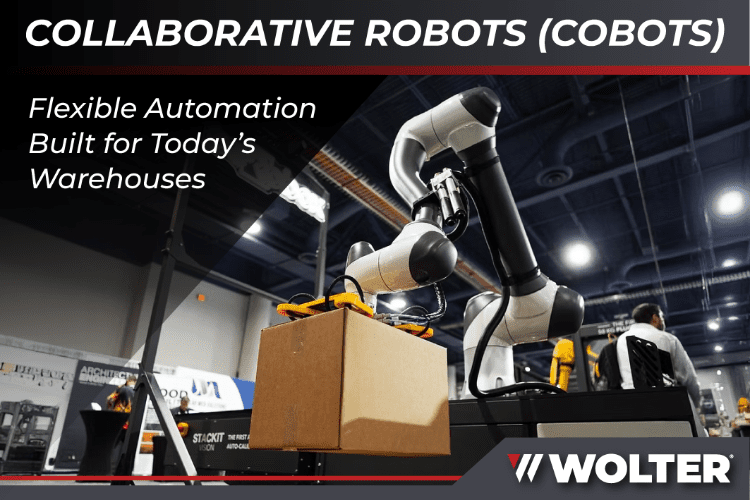
Collaborative Robots : Flexible Automation Built for Today’s Warehouses
As warehouses and manufacturing operations face ongoing labor shortages, rising costs, and increased demand for speed and accuracy, automation has become essential. One of the fastest-growing and most accessible automation solutions is collaborative robots commonly known as cobots.
Cobots are designed to work safely alongside human operators, helping companies improve productivity without the complexity or cost of traditional industrial robots.
What Are Collaborative Robots (Cobots)?
Collaborative robots are automated systems built with advanced safety features that allow them to operate near people. Unlike traditional robots that require safety cages and restricted zones, cobots are engineered with force-limiting technology, sensors, and vision systems that enable safe human- robot interaction.
This makes cobots ideal for facilities looking to automate repetitive or physically demanding tasks without fully re-engineering their operation.
Why Cobots Are Gaining Momentum
Cobots offer a unique combination of flexibility, safety, and return on investment. Key advantages include:
- Improved Labor Efficiency – Cobots handle repetitive tasks so employees can focus on higher-value work
- Quick Deployment – Minimal programming and fast setup reduce downtime
- Safe Human Collaboration – Built-in safety features allow cobots to work alongside people
- Scalable Automation – Easy to redeploy as workflows change
- Lower Cost of Entry – Less infrastructure required compared to traditional robots
For many operations, cobots provide a practical first step into automation.
Common Cobot Applications in Warehousing & Manufacturing
Cobots are highly versatile and can be deployed across a wide range of tasks, including:
- Case packing & palletizing
- Pick-and-place operations
- Machine tending
- Quality inspection & testing
- Light assembly and kitting
By taking on repetitive motions, cobots reduce worker fatigue, improve consistency, and enhance overall throughput.
How Cobots Fit Into a Smarter Automation Strategy
Cobots work best when they’re part of a holistic automation strategy. When integrated with conveyors, mobile robots (AMRs), warehouse software, and material handling equipment, cobots help create a more balanced and efficient workflow.
At Wolter, collaborative robots are evaluated as part of the entire operation, ensuring they:
- Integrate seamlessly with existing systems
- Deliver measurable ROI
- Support long-term growth and scalability
The Future of Collaborative Automation
As technology continues to advance, cobots are becoming more intelligent, mobile, and capable. With improved vision systems, AI-driven decision-making, and easier integration, cobots will play an even greater role in modern warehouses and manufacturing facilities.
For companies looking to increase efficiency while maintaining workforce flexibility, cobots represent a smart, scalable automation solution.
Is a Collaborative Robot Right for Your Operation?
Cobots aren’t a one-size-fits-all solution but for many operations, they offer a fast, cost-effective way to improve productivity and reduce strain on workers.
Partnering with an experienced automation provider ensures the technology is applied correctly and delivers long-term value.
Wolter helps companies evaluate, design, and implement collaborative robot solutions that fit their operation not the other way around. Click here to contact an automation rep today.
