
Share
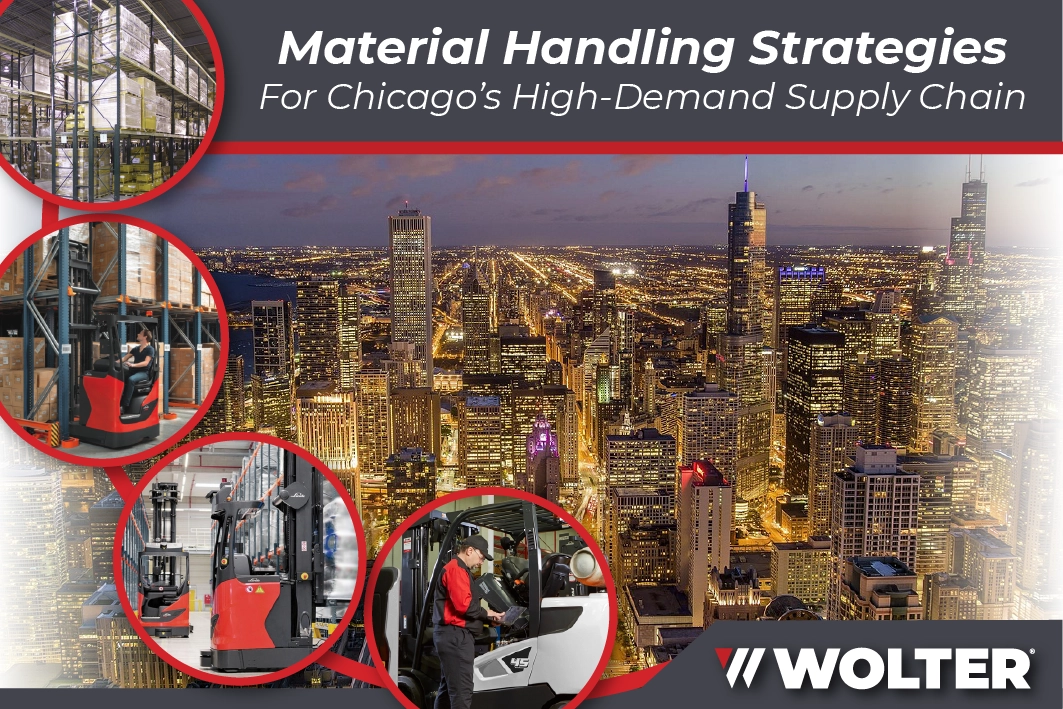
Material Handling Strategies for Chicago’s High-Demand Supply Chain
Chicago sits at the center of one of the most active supply chain regions in North America. With dense industrial corridors, major intermodal access, and a constant flow of inbound and outbound freight movements, Chicagoland facilities face daily pressure to move products faster, safer, and more efficiently. To stay competitive, companies across the region are rethinking their material handling strategies to improve throughput, control cost and support long term growth.
Designing Warehouses for Space Optimization and Throughput
Many Chicago-area warehouses operate in older buildings or high-density industrial parks where expanding square footage isn’t an option. As a result, maximizing existing space is a core material handling strategy.
Successful facilities focus on:
- Narrow-aisle and very narrow-aisle layouts
- High-density racking systems
- Equipment designed for tight turning radius
- Optimized pick paths to reduce travel time
The right material handling strategy allows operations to increase throughput without increasing their footprint this is critical in a competitive real estate market like Chicago.
Improving Labor Productivity Through Equipment Standardization
Labor availability remains a challenge across the Chicago metro area. Facilities are responding by simplifying operations through fleet standardization and operator-friendly equipment.
Strategic equipment choices include:
- Consistent truck models across shifts and departments
- Ergonomic designs that reduce fatigue and injury risk
- Intuitive controls that shorten training time
- Equipment that supports multi-tasking operators
By standardizing material handling equipment, Chicago businesses improve productivity while making it easier to onboard and retain employees.
Electrification and Energy Efficiency in Chicago Warehouses
Electric material handling equipment has become the standard across many Chicagoland facilities, particularly in food, beverage, manufacturing, and indoor distribution environments.
Strategic benefits include:
- Lower operating and maintenance costs
- Reduced emissions and improved indoor air quality
- Better performance in cold storage and refrigerated spaces
- Compatibility with sustainability and ESG initiatives
Advanced battery technologies, including lithium-ion, further support around-the-clock operations by minimizing charging downtime and simplifying energy management.
Targeted Automation for High-Volume Distribution
Automation continues to grow across Chicago’s (logistic centers) supply chain. The most successful strategies focus on targeted implementation rather than full facility automation.
Common strategic applications include:
- Automated pallet transport for repetitive moves
- Semi-automated order picking solutions
- Fleet management systems that track usage and performance
- Integration with WMS and warehouse control systems
These technologies help Chicago facilities handle higher volumes without increasing labor costs or sacrificing accuracy.
Minimizing Downtime with Proactive Fleet Maintenance
Downtime in Chicago’s high volume logistics environment is costly. With tight shipping windows and high customer expectations, material handling strategies must prioritize reliability and service support (responsiveness).
Key considerations include:
- Preventive maintenance programs
- Data-driven fleet monitoring
- Fast local service response
- Equipment built for high-cycle operations and lower downtime
A proactive approach to maintenance and fleet management keeps operations running even during peak seasons.
Building a Long-Term Material Handling Strategy
Chicago’s (logistics environment) supply chain isn’t slowing down. Facilities that take a long-term view of material handling focusing on flexibility, scalability, and efficiency (to) are better positioned to adapt to market changes.
A strong strategy balances:
- Current operational demands
- Labor and space limitations
- Sustainability goals
- Future automation readiness
By planning for and investing in the right material handling strategy today, Chicago’s supply chain businesses can support growth, control costs, and remain competitive in one of the most demanding logistics markets in the country.
Partner with Wolter for Material Handling Solutions in Chicagoland
At Wolter, we understand the operational pressures facing Chicago-area warehouses, manufacturers, and distribution centers. Our team helps businesses improve warehouse efficiency, optimize forklift fleet management, and implement scalable material handling solutions in Chicago and the Midwest.
From space optimization and narrow-aisle equipment to lithium-ion forklift power, automation integration, and preventive maintenance programs, Wolter delivers solutions designed to increase productivity and reduce operating costs.
Whether you’re upgrading equipment, improving uptime, or planning for future growth, Wolter provides:
- Industry-leading material handling equipment in Chicago
- Expert forklift fleet optimization and energy solutions
- Warehouse automation and distribution efficiency strategies
- Responsive local forklift service and maintenance support
Let’s build a smarter, more efficient operation together.
Contact Wolter today to schedule a facility assessment and discover opportunities to improve productivity, safety, and long-term performance across your Chicagoland operations.
