Designing High-Density Storage Solutions for a Food Processing Company
Opportunity: A leading food processor needed to consolidate multiple, outdated facilities into a single, modern operation while maintaining production capabilities & aligning with the strict requirements of a food-grade environment.
This required careful planning around inbound materials work-in-process, finished products, & varying pallet weights & dimensions.
The operation needed to maintain both accurate & agile inventory control in refrigerated environments, while balancing storage density with accessibility. The layout had to support both high-throughput movement & selective picking, all while maintaining safe interaction between lift truck traffic & personnel within the facility.
Solution: Wolter developed a multi-system storage design that aligned with the operational needs of each area within the plant.
Alongside the production lines, storage solutions were designed to support packaging operations with easy access. Selective racking combined with carton flow systems allowed materials such as labels & packaging components to be stored above, while enabling access at lower levels for line-side picking. This approach improved efficiency & minimized disruption to production.
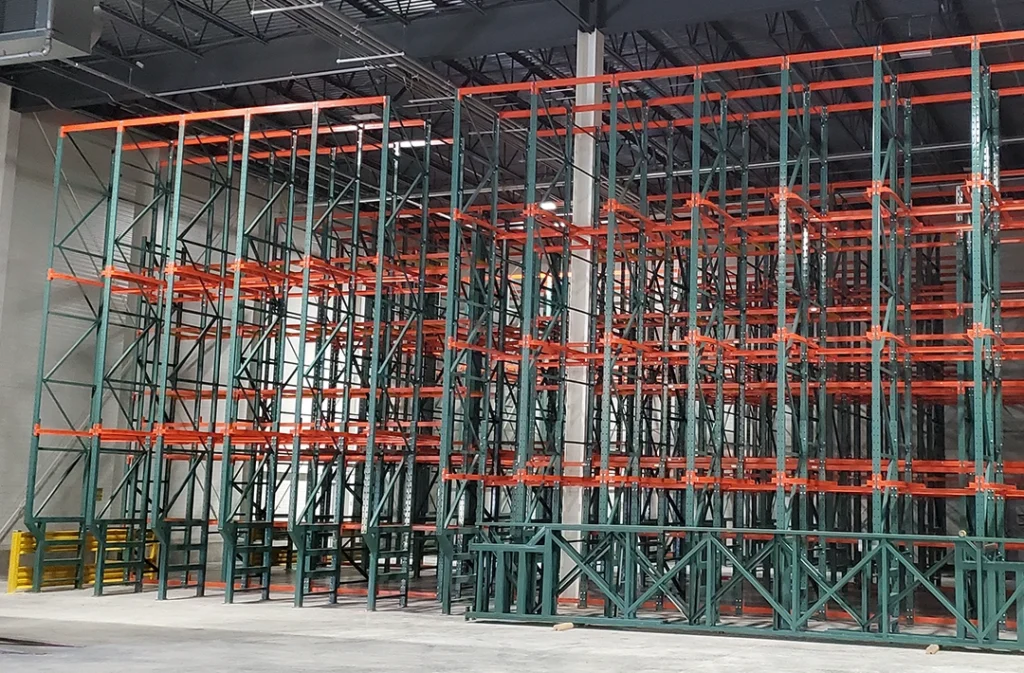
For finished goods, high-density drive-in racking was selected to support both full & partial shipments. This system allowed for efficient staging & retrieval based on shipping demands, also maximizing available storage within the refrigerated space.
In the cold storage area, very narrow aisle (VNA), wire-guided selective racking was implemented to provide full selectivity while maintaining FIFO compliance. The system included staging locations, allowing pallet loads to be efficiently transferred into storage with minimal aisle space required.
In the dry storage warehouse, a combination of double-deep selective racking & push-back racking was implemented to balance density with flexibility. This allowed the facility to accommodate multiple different pallet sizes while organizing inventory based on product throughput & shelf life. Faster-moving, perishable materials were positioned within push-back systems, while slower-moving inventory & packaging materials were stored within double-deep configurations.
Within the tempering area, where palletized product was stored in order to reach optimal temperature for processing, structural drive-in racking was utilized to maximize storage density. This solution aligned with the operational flow, as product was cycled in full batches, eliminating concerns around selectivity & allowing for full use of the space. The system was reinforced to accommodate heavy pallet loads & the demands of lift truck operation in tighter environments.
A dedicated area for quality assurance & sample storage was also integrated into the design. Light-duty selective racking within a refrigerated section of the facility provided organized storage for sample materials. This area was separated from lift truck traffic using protective guardrail systems, ensuring safe access for personnel while maintaining operational flow.
Results: The final solution delivered a highly optimized storage environment that supported both current operational demands & future scalability. Storage density was increased across all temperature zones, while maintaining the necessary levels of selection & accessibility.
The facility benefited from improved inventory flow, more efficient batch processing, & streamlined replenishment processes. Safety was enhanced through thoughtful system design & clear separation between equipment & pedestrian traffic.
This project highlights the importance of aligning storage system design with real-world operational requirements utilizing a consultative approach. By leveraging a data-driven approach & applying the appropriate storage technologies in each area of the facility, Wolter delivered a solution that improved efficiency, maximized space, & supported long-term growth.
The result is a highly functional, scalable environment that enables the customer to operate at a higher level of performance across all aspects of material handling & storage.